

Here's our summary of key economic events overnight that affect Australia with news the bond market is dominating the news today with sharply rising long term yields as investors see no end in sight to the war inflation upon us now.
The benchmark US Treasury 10 year yield is now up to its highest since the brief October 2025 spike, and before that, it highest since 2023. In those earlier peaks, there was nothing like the fundamental inflationary pressure building now. And the US Treasury 30 bond yield is now at its highest since 2007.
And if it lasts, yield asset valuations are at risk, especially real estate. There is already severe valuation pressure in the commercial office market from low demand. A higher cost of money could do widespread damage to these market valuations, globally.
But first today in the US, private employers added an average of 42,250 jobs per week in the four weeks to May 2, up from 33,000 in the prior period, according to the ADP Research. Strong hiring in healthcare is a key feature.
US pending home sales rose +1.4% in April from March to be +3.2% higher than year-ago levels. But the recent modest rises are not yet enough to make back the big falls in December and the small fall in January. The sharply rising 30 year bond rates will likely affect this market going forward.
In Canada and as expected, their headline CPI inflation rose 2.8% in April from 2.4% in March and the highest in two years, But this is notably lower than the expected 3.1% rate and probably takes the pressure off their central bank to raise rates.
In Japan, they said their GDP came in with a +2.1% (real) annual expansion are in Q1-2026, up from the +0.8% in Q4-2025. A rise was anticipated but only to +1.7%.
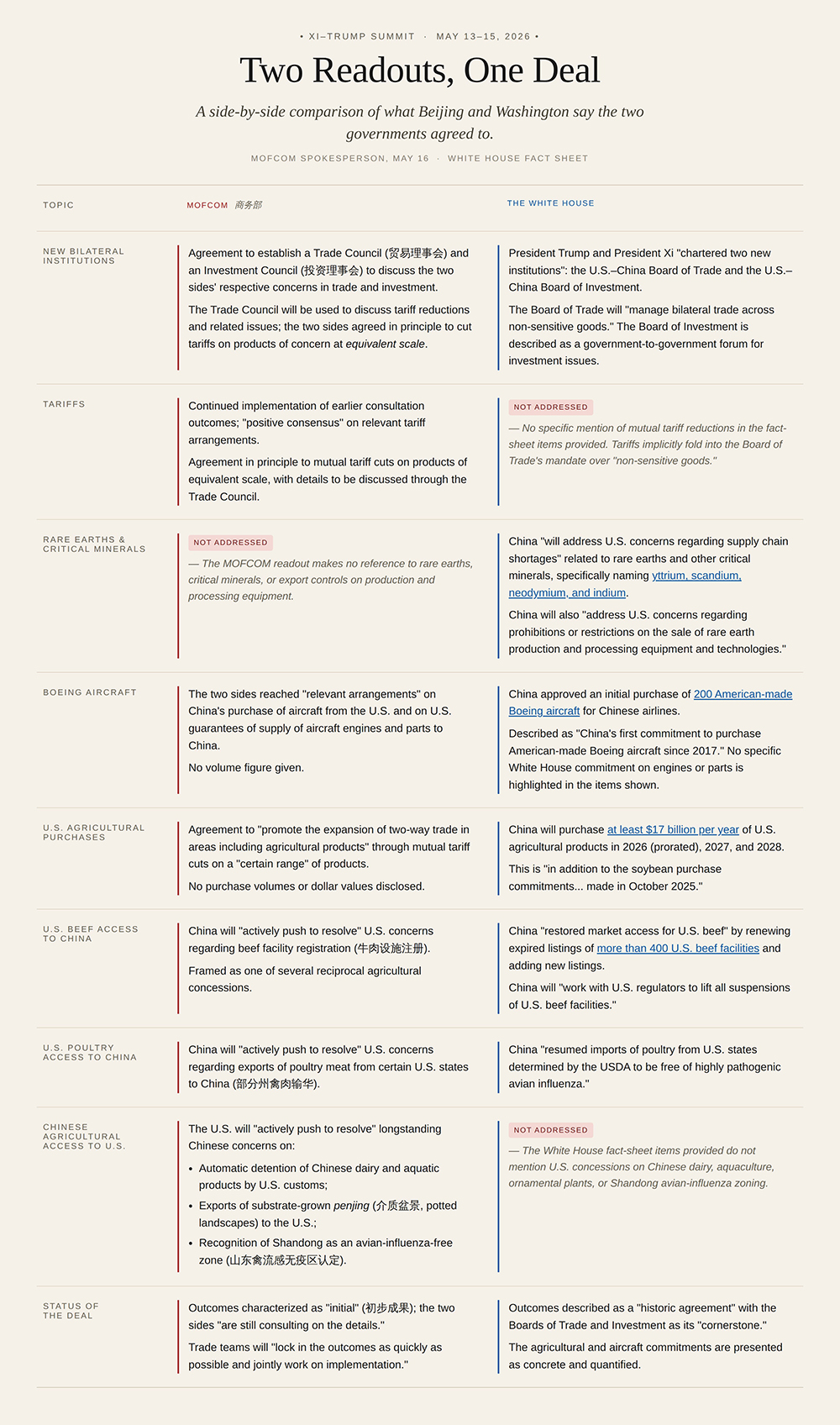
In China, the always excellent Bill Bishop has used AI (Claude) to compare what the Chinese think was accomplished, with what the US think. It is here. There is some overlap. But there is clearly much confusion on what was actually agreed. Basically we should expect both sides to accuse the other of reneging - and in turn, the great rivalry will just fester on.
In Malaysia, their inflation came in at 1.9% in April , at the low end of their expected level and only a modest rise from March. It was their most however since July 2024.
In Europe, they posted a smaller trade surplus than expected as exports underwhelmed in March and imports rose. It was a much lower surplus that they recorded a year earlier.
Here in Australia, the Westpac-Melbourne Institute consumer sentiment survey is picking up a range of recent trends. Sentiment improved marginally despite the fuel shock, but within that more people are downbeat on their economy. The Canberra Budget didn't have a big impact though. Job loss fears are still elevated even if slightly less so. But homebuyer sentiment is down sharply to deeply pessimistic levels. And consumer house price expectations have softened even if they are still positive. A key thing to watch is the widening sentiment gap between young and old. The ‘baby boomer’ and ‘Generation X’ cohorts are extremely weak (angry). Sentiment amongst ‘Millennials’ is only modestly pessimistic. But ‘Generation Z’ is outright positive they note.
Rich people whingeing over losing their tax advantages in the latest Australian Federal Budget is becoming a feature of public discourse here, especially in the real estate sector.
The UST 10yr yield is now just on 4.67%, up +8 bps from this time yesterday. The key 2-10 yield curve is now at +56 bps (+6 bps). Their 1-5 curve is now at +49 bps (+4 bps) and the 3 mth-10yr curve is at +104 bps (+9 bps). The China 10 year bond rate is now at 1.74%, down -1 bp from yesterday. The Japanese 10 year bond yield is up +6 bps at 2.79% and new a 30 year high. The Australian 10 year bond yield starts today at 5.10%, up +2 bps from yesterday.
Wall Street softer today, looking over its shoulder at the bond market, with the S&P500 down another -0.7%. Overnight European markets closed little-changed between Paris's -0.1% and Frankfurt's +0.4%. Yesterday Tokyo ended its Tuesday trade down -0.1%. Hong Kong rose +0.5%. Shanghai rose +0.9%, and Singapore was up +1.5%. The ASX200 ended up +1.5%.
The price of gold will start today down -US$47 at US$4500/oz. Silver is down -US$2 at just over US$74.50/oz.
American oil prices have fallen -US$3.50 to just on US$103.50/bbl, while the international Brent price is now at just over US$110/bbl, down only -50 USc.
The Kiwi dollar is down -40 bps from yesterday at this time at 71.1 USc. Against the Japanese yen we are down -70 bps at ¥112.9. Against the euro we are down -10 bps at just on 61.3 euro cents.
The bitcoin price starts today at US$76,771 and up just +0.1% from this time yesterday. Volatility over the past 24 hours has been low at just under +/- 0.9%.
Comments
We welcome your comments below. If you are not already registered, please to comment.
Remember we welcome robust, respectful and insightful debate. We don't welcome abusive or defamatory comments and will de-register those repeatedly making such comments.
Please to post comments.