

Content sourced from Cotality, here.
Cotality’s national Home Value Index (HVI) dropped 0.4% in June, marking the largest month-on-month fall since December 2022.
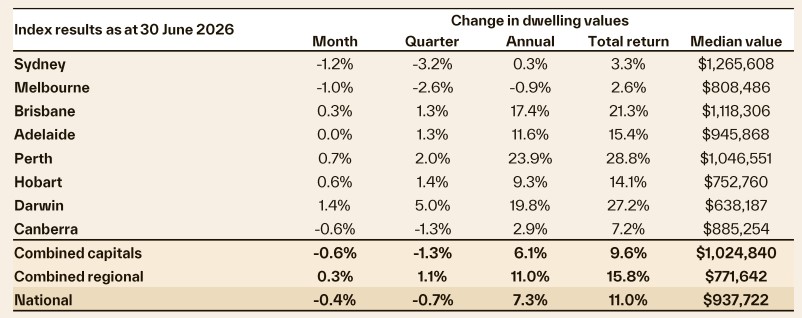
The mid-sized capitals recorded a sharp slowdown in their rate of growth. Adelaide values were unchanged over the month, while Brisbane and Perth saw modest month-on-month rises of 0.3% and 0.7%, respectively. This represents a material slowdown relative to the pace of gains through the March quarter, when Brisbane values rose at an average monthly pace of 1.9% and Perth at 2.5%.
As the market rapidly decelerates, the HVI has seen recent months revise lower. The June update now indicates the national measure peaked in March, with values down 0.7% through the June quarter.
“The downward revision reflects a market that is changing rapidly,” said Cotality’s research director Tim Lawless. “Most regions have seen values revise lower over recent months, with the largest downgrades occurring in Perth and Brisbane, where the May index has been revised 88 and 53 basis points lower with the June update.”
The June quarter marks a significant shift in Australia’s housing dynamic. Capital city home values have fallen by 1.3% over the quarter, with Sydney leading the pace of decline at -3.2%. Melbourne values were down 2.6% through the quarter, and ACT values are 1.3% lower.
“Weaker conditions through the second quarter of the year are attributable to an array of downside factors,” said Mr Lawless. “Even before interest rates rose by seventy-five basis points, we were seeing affordability hurdles weighing on buyer demand. Higher cost-of-living pressures, deeply pessimistic sentiment and a further dampening of demand via property taxation changes announced in the federal budget are all contributing to weaker housing conditions.”
A weaker housing market can be seen across other metrics, including auction clearance rates, estimates of home sales and the number of properties listed for sale.
The combined capital cities auction clearance rate has held below 50% since the last week of May, dropping to the low 40% range from late June.
Capital city home sales, over the three months to June, are estimated to be 16.2% lower than at the same time last year and 14.5% below the five-year average for this time of year.
At the same time, advertised supply across the capitals is in line with the five-year average (-0.1%) but almost 11% higher than a year ago.
“Such low clearance rates indicate a mismatch between buyer and seller pricing expectations. Buyers now have more stock to choose from and less urgency in their decision-making,” Mr Lawless said.
“Higher listings aren’t due to a pick-up in the flow of new listings; it’s a symptom of less demand in the market, which has led to an accumulation of advertised stock.”
Outside the capital city trends, regional markets continue to outperform their capital city counterparts. Broadly, the combined regional index was up 0.3% in June and was 1.1% higher over the quarter, although the pace of gains is clearly slowing across regional Australia as well.
Regional Vic recorded the weakest result, with values down 0.1% in June, while values were flat across regional NSW over the month. Regional WA remains the strongest market across the broad regions of Australia, with values up 3.7% in the June quarter.
Comments
We welcome your comments below. If you are not already registered, please to comment.
Remember we welcome robust, respectful and insightful debate. We don't welcome abusive or defamatory comments and will de-register those repeatedly making such comments.
Please to post comments.