

Cotality’s national Home Value Index fell 1.1% in September, the sixth straight month of falling values. On a national basis, dwelling values are now 5.2% below their record highs from March 2026.
Every capital city except Darwin recorded a fall in home values through the first month of spring, along with 71% of the regional SA3 sub-markets recording a decline in values over the month.
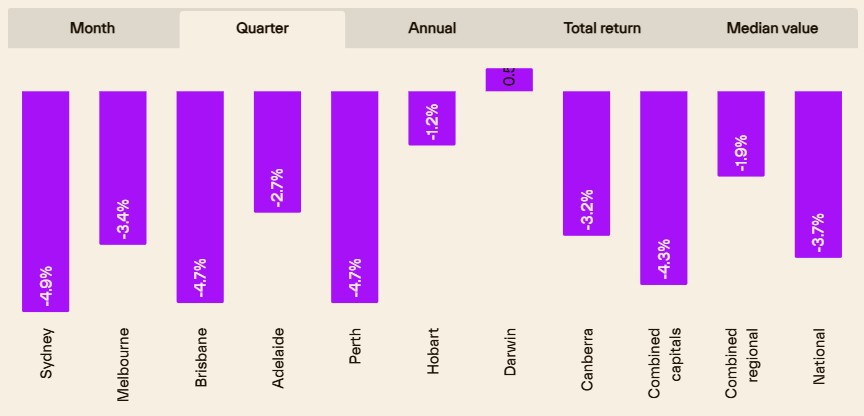
Tim Lawless, Cotality’s research director notes almost every capital city suburb was down in value over the past three months. “97% of capital city suburbs were down in value over the three months to end of September, highlighting the broad-based scope of this negative housing cycle.”
The housing downturn reflects a combination of affordability constraints, higher interest rates, elevated living costs, and weaker consumer sentiment, all of which have reduced purchasing capacity and dampened buyer demand.
Brisbane recorded the sharpest monthly decline among the capitals in September, with values down 1.5%, edging past Sydney's 1.4% fall. The result highlights how sharply conditions have shifted in what had previously been one of the strongest performing housing markets. Melbourne is now showing a milder rate of decline, at -0.7%, than each of the mid-sized capitals where values were down more than 1% in September.
Sydney continues to lead the housing correction, with values now 8.6% below their February peak. The decline is marginally deeper than the equivalent stage of the 2022-23 downturn, highlighting how rapid demand has weakened across the nation's largest housing market.
Melbourne values are 7.2% below their cyclical high in November last year and 7.5% below the record high from March 2022.
On an annual basis, the national outcome has been flat (0.0% change in values), but some markets are still showing strong annual gains, reflecting the period of growth through 2024 and early 2026. Perth (10.1%) and Darwin (11.9%) have recorded the highest annual gains, while Sydney (-7.0%) and Melbourne (-6.2%) are well into negative annual change and Canberra home values are also lower over the year, down a more modest 1.6%.
Regional markets continue to prove more resilient than the capitals, with regional dwelling values up 5.6% annually compared with a 1.8% annual decline across the combined capitals.
Housing turnover has also eased, with estimates of the number of home sales over the past three months tracking 19.1% lower than a year ago nationally and 13.3% below the previous five-year average. The volume of home sales relative to a year ago was down most sharply in Brisbane (-27.2%), with Sydney (-26.5%) and Perth (-24.2%) also recording an annual decline in sales of more than 20%.
“The sharp drop in sales has implications for the broader economy, with lower sales likely to hit some retail segments as well as stamp duty revenues for state governments,” Mr Lawless said.
As housing demand continues to ease, advertised supply levels have accumulated, despite a reduced flow of fresh listings coming to market. Across the combined capitals, the flow of new listings added to the market was 9.2% lower than a year ago, but total inventory was tracking 23.1% higher.
“Despite fewer new listings entering the market, inventory levels have risen sharply because the rate of sale has fallen even faster. Capital city homes are now taking a median of 39 days to sell compared with 23 days a year ago, resulting in an accumulation of advertised supply,” Mr Lawless said.
“The lift in available stock is improving choice for buyers, but ironically, many prospective buyers don’t have the confidence or financial capacity to buy at the moment.”
Comments
We welcome your comments below. If you are not already registered, please to comment.
Remember we welcome robust, respectful and insightful debate. We don't welcome abusive or defamatory comments and will de-register those repeatedly making such comments.
Please to post comments.