

There is a lot of action in the rate offers for savers - driven by Macquarie's appetite to build its household deposit base.
This has been remarkably successful, and driven its competitors to respond.
Macquarie started with sharp increases in at-call savings rates. The other big banks responded with higher term deposit rates.
The latest shift has been from NAB who now have a 4.25% one year term deposit rate. That isn't very unique, just a reflection that they have to respond to the competitive challenge.
So the question arises, where have these higher rates settled? Is it better to keep your savings short (at call) if these rates almost match term deposit rates (which require you to lock the funds up)?
Here is where we stand today, on a 'best rates' basis (but ignoring the 3 or 4 month 'welcome rates' - which revert to much lower levels after that initial period):
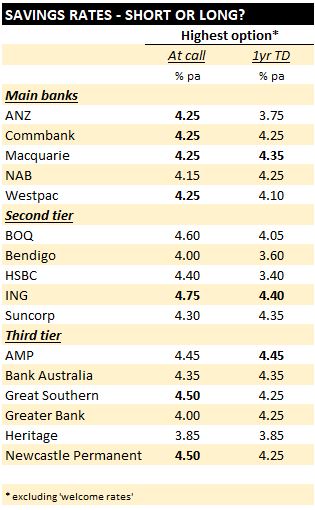
The challenger banks have found life difficult in this really competitive environment, one that is being led by the main banks. That difficulty has required them to offer a premium to the already high rates. And banks like ING, Bank of Queensland, AMP and Great Southern actually have the highest rates of any banks now.
On average, at-call savings rates across all the banks listed in our table above currently average almost +20 bps higher than the one year TD rates. ING's 4.75% savings rate is a standout offer.
Clearly, if floating rates are going to fall in the plannable future, grabbing a high fixed rate now makes sense. But we aren't actually in that situation. At best, rates will likely just hold. But there is more of an argument that they will rise, biven background geopolitical risk, and local inflation risk.
For perspective, the main banks control 79% of all household deposits, the second-tier challengers control 11%, and that only leave 10% for all the others and about half of that in our "third tier' group listed above). There was $1.7 tln in household deposits at the end of November, 2025.
You can find a full list of savings rates, across all bank 'products' here. There are similar tables for term deposits 1-11 months here, and for rates 1 year and longer here.
Comments
We welcome your comments below. If you are not already registered, please to comment.
Remember we welcome robust, respectful and insightful debate. We don't welcome abusive or defamatory comments and will de-register those repeatedly making such comments.
Please to post comments.