

More banks are raising term deposit rates.
Today it is Westpac, who raised their one year 'special' to 4.80% and their two year 'special' to 4.90%.
But that rising pace wasn't enough to close the gap on Macquarie, who now have a six month rate at 4.90%, a nine month rate at 4.95%, and a one year TD rate of 5.10%.
If you like shorter terms, ING has the new rate of 5.00% for six months - and one year.
As we pointed out yesterday (before these latest rises), there are a number of banks with 5%-or-higher term deposit rates.
And today, the ABS has released its February inflation data. We now have to deal with 3.7% inflation.
If you don't want your bank savings to be devalued by inflation, you need to earn more than that.
But there is a cost layer standing in between the advertised bank term deposit rates, and what you need to cover inflation. That cost is the income tax. It is only staying equal or ahead if your after-tax return is better than inflation. So, how do you work that out?
First, you need to know your marginal income tax rate. This table will help ...
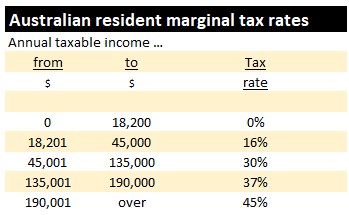
Then you can assess a bank TD rate offer. You do it by taking the offered rate, deducting the tax rate, and comparing the result to the 3.8% inflation rate.
Here is a ready reckoner for a wide range of term deposit offers, the latest inflation rate, and the current income tax rates.
Choose the column for the tax rate that applies to you.
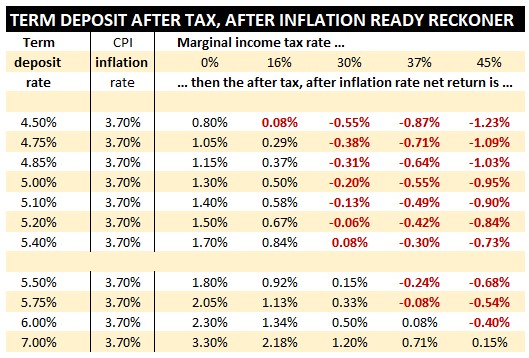
You can hold your own with term deposit rates, perhaps make a small real gain, only if you currently have a taxable income of less than $45,000 pa. But you are on the losing side of it when your annual taxable income is higher.
The same table shows that only when term deposit rates reach 7% - and CPI inflation is 3.7% or lower, will anyone on a $135,000 income or higher keep the purchasing power of their deposit capital sum.
Term deposit 'investment' isn't for everyone. But it is 'safe' and if you cannot afford to risk your capital sum, any interest earned is better than none. However, you need to accept that your net real position is likely to atrophy over time.
Comments
We welcome your comments below. If you are not already registered, please to comment.
Remember we welcome robust, respectful and insightful debate. We don't welcome abusive or defamatory comments and will de-register those repeatedly making such comments.
Please to post comments.